The colloid osmotic pressure (COP) is a special case of osmosis.
COP appears at semipermeable membranes which are well permeable for water and substances with molecular weights up to
several thousands, but are impermeable for colloids, e.g. plasma
proteins.
Wilhelm PFEFFER first described osmotic phenomena in plant
cells (1877). He measured them with the first osmometer. Jacobus Hendricus VAN'T HOFF described them theoretically (1887).
Ernest H. STARLING, the great physiologist, discovered the phenomenon of colloid osmotic pressure and its important role in balancing the capillary transmural fluid exchange (1896). lt was
Starling who built the first colloid osmometer with a peritoneal
membrane, and he used it for the first direct measurement of colloid osmotic pressure in canine serum. Measurement then took
three to four days.
COP is indeed the “antagonist” of the intra-capillary hydrostatic
pressure, both being equally important for the interstitial fluid balance. But until recently, COP could not be measured in clinical
diagnosis because there were no colloid osmometers available,
simple and sturdy enough for the routine.
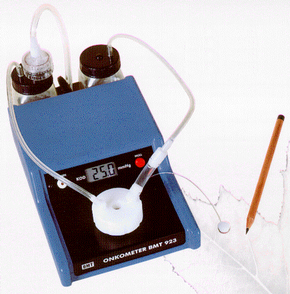
The new ONKOMETER BMT 923 is unsurpassed in simplicity of
both measurement and maintenance. Measurement takes less
than two minutes, and the device automatically holds the right
steady state value of the displayed COP.
The ONKOMETER BMT 923 is sturdy and simple for use in the
clinical practice.
COP of capillary blood has to be judged in reference to the hydrostatic blood pressure in these capillaries and in the neighbouring venoles, to the hydrostatic pressure in the surrounding
interstitial spaces, and to the COP of the interstitial fluid. Both of
the latter can hardly be measured.
Nevertheless the knowledge of blood COP, and its trend, gives
indications of high clinical significance, e.g.
• how to get aware of pulmonary edema in statu nascendi
• when to start IV infusion of plasma protein solutions
• when to stop it
• when protein infusion is contraindicated
• what happens with high molecular IV solutions after infusion
• how to avoid superfluous infusion of protein solutions
• how to monitor COP in extracorporeal circulation with the
heart lung machine
• how to manage colloid balance in peritoneal dialysis
• how to anticipate EPH gestoses and pre-eclampsia in gynecology
• how to anticipate cerebral edema in neuro-surgery
COP is correlated statistically with plasma protein concentration,
physiologically and even in intensive care patients. But this correlation needs not necessarily be valid for the individual patient.
Correlation may fail totally for the critically ill, e.g. for burn victims.
When COP is normal, IV infusion of protein solutions may be the
wrong therapy, even if the patient’s plasma protein concentration
is low. This is true especially when COP cannot be improved by
infusion of protein solutions.
In intensive care medicine, albumen therapy should always be
accompanied by COP measurement of the patient’s blood.
Avoiding superfluous IV infusion of expensive plasma protein
solutions, however, can redeem purchase of a colloid osmometer
within a short time.
Since routine measurement of COP has become available only
recently, it is a true paradox that a basic physiologic parameter
can still be investigated by pioneers. The ONKOMETER
BMT 923 is the right tool for them.
 Sale
Sale